

Share with Community!
Replace Scrolling With Scoring: Understanding Comes Before Speed
- Job search has a looks productive trap: lots of clicks, little signal.
- OptimCareers tracked 47 job seekers and found interview rates drop as volume rises and customization drops, with the steepest decay at 150+ applications.[1]
- Scoring is a simple filter turn each job post into a few signals so you can decide how much effort it deserves.
- A score is only useful if it's explainable (why?) and actionable (what next).
Job search has a looks productive trap, lots of clicks and little signals
You can spend two hours scrolling and feel like you did something, but still have zero clue what actually moved you closer to an interview. Here's the shift, stop treating job search like browsing. Treat it like a system you can debug.
And the first step in any system is always the same, make the inputs measurable.
The busy but stuck loop
Scrolling is frictionless, which is why it's dangerous. It creates motion without forcing decisions. Most juniors end up in this loop:
- Find roles that sound fine
- Apply quickly
- Repeat
- Get silence
- Conclude nobody is hiring
Sometimes 'nobody is hiring' is emotionally accurate. But functionally it's not useful, because it doesn't tell you what to change.
Why more applications can make results worse
There's data behind the ‘spray and pray backfires’ feeling. OptimCareers tracked 47 job seekers over six months and documented a clear pattern, as application volume rises and customization drops, interview rates fall.[1]
They show interview rate drop across volume groups,[1]
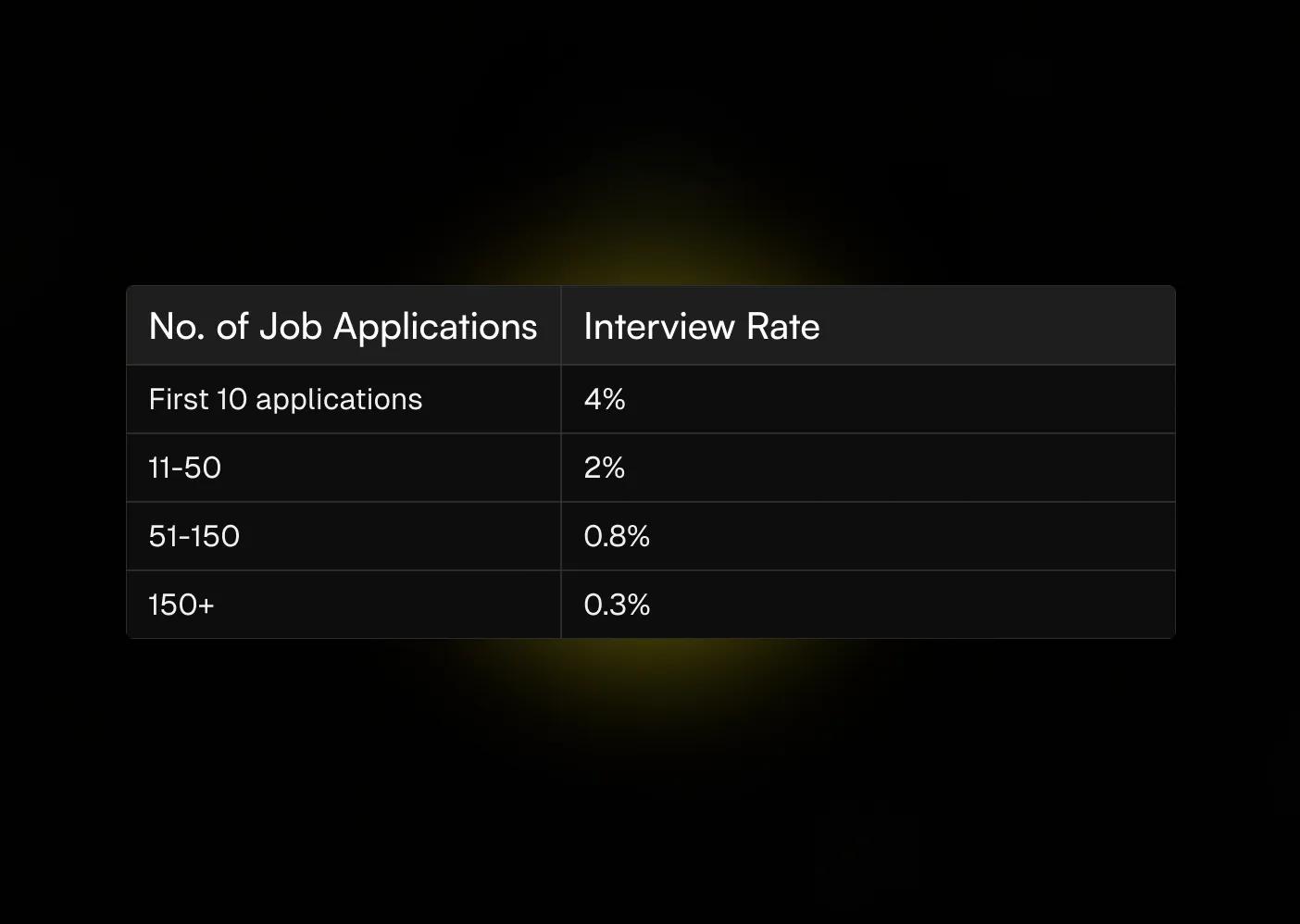
The apply more strategy often fails because volume steals time from the only things that compounds i.e. targeting, tailoring, and preparation.[1]
The principle, speed amplifies your strategy
Speed is not inherently good. Speed just amplifies whatever strategy you already have. If your strategy is unclear fit, low signal postings, no verification and minimal tailoring. Then speed just means you reach rejection faster.
If your strategy is high signal postings, clear constraints, strong fit proof and intentional tailoring. Then speed is a weapon.
Scrolling is a UI. Scoring is a filter.
Scrolling treats every job as maybe. Scoring forces a better question Is this worth my time?
There's no need of complex rubric. Just a few signals that turn a job post into something you can decide on.
The point of scoring isn't perfection. The point is clarity.
A validated scoring model
This model isn't validated because it looks neat. It's validated because it matches the failure points OptimCareers measured, when you remove selectivity, outcomes decay.[1]
Here’s what I think is a good criteria to make this decision quickly;
Signal 1: Role Fit proof
Can you prove, You can do the job with projects and internships. so simply a few measurable outcomes? If you can't prove it, you're betting on kindness in a system optimized for filtering.
Signal 2: Constraint check
Some constraints dominate outcomes, regardless of how good you are
- work authorization / sponsorship
- location / onsite requirements
- strict YOE gates
- clearance requirements
- niche domain requirements
These aren't challenges. They're gates. Treat them as binary signals when you can, because arguing with a gate is how people waste tons of time.
Signal 3: Posting quality
This is not ghost job paranoia. It's basic quality control.
- High signal postings tend to be specific, they include requirements that aren't a wishlist copied from somewhere.
- Low-signal postings tend to be vague or recycled
Signal 4: Timing/process
Timing isn't magic. But it changes the pile you land in. A fresh posting can mean;
- less saturation
- more active review
- higher chance a recruiter sees your application before it becomes part of the 1000 applicants blob
Old postings can still be open, but you should treat them as higher risk unless you have a reason to believe they're actively reviewed.
P.S.: To understand more on why recency matters, read this.
Signal 5: Effort-to-upside (ROI)
If the application takes 45 minutes (forms, essays, tasks), the posting must be high signal enough to justify that time.
OptimCareers' dataset makes this point painfully clear; as volume increases, customization decreases, interview chances decrease, and the whole process worsens up to interview performance and offers.[1]
They even report a big gap in interview to offer conversion[1]
- Specific, prepared answers = 31% conversion
- Generic answers = 8% conversion
This is what you'd expect when people have time to prepare for fewer targets.[1] So effort is not good.
Effort is only good when it's concentrated where odds and upside justify it. And this is how you can make sense of the outputs, the goal isn’t higher application quality in isolation, it’s answering one question fast: Should I apply to this job?
What a score is supposed to do
A score isn't meant to decide for you. A score is meant to reduce guessing.
A good score should be:
- explainable
- actionable
- honest about unknowns
Where Proism fits
This is what Proism's job matching breakdown shows, it turns a vague match into a breakdown that is easy to understand.
A few platforms that support the same idea
This scoring before speed direction isn't unique to Proism.
- Jobright describes job matching as analyzing your resume plus preferences (location and other parameters) and matching against job descriptions, then using a "match score" to rank fit.[2]
- Canyon positions its resume optimizer as tailoring your resume to a specific job description and includes a "resume score" with real-time feedback and actionable steps to improve it.[3]
Different solutions claiming same underlying truth, selection and clarity are the bottleneck, not speed or Volume.
A simple 7 day operating loop
If you want this to be real, run this for a week
- Build a small apply list using the 5 signals above
- Apply with enough tailoring that your resume matches the job language and requirements (not keyword spam, but actual alignment).[1]
- Track conversion: views, screens, interviews
- After some applications, evaluate patterns and share findings (r/Proism)
OptimCareers explains why this works, “selective applicants identify and fix issues 3-4× faster” because their data is interpretable, they adjust path based on signals not noise.[1]
Conclusion
Scrolling makes you feel busy. Scoring makes you effective.
References
[1] OptimCareers. (2025). "Application Velocity vs. Application Quality: The Mathematical Case for Selective Job Hunting." Retrieved December 18, 2025, from https://optimcareers.com/expert-articles/application-velocity-vs-application-quality
[2] Jobright. (2025). "AI Job Matching." Retrieved from https://jobright.ai/ai-job-match
[3] Canyon. (2025). "AI Resume Builder - Use AI to Build and Perfect Your Resume." Retrieved from https://www.usecanyon.com/features/ai-resume-builder
All it takes is One-Click
Ready for the hunt?