

Share with Community!
The Recency Rule for Junior SWE Applications: A Decision Model (Not Advice)
TL;DR
Most companies review applications on a rolling basis, they evaluate as applications arrive, not at a deadline.[1] Post age tells you whether you're competing in an early batch or a saturated queue. Use three signals to score each role: Recency (0–24h = best, 24–72h = good, 72h+ = risky), Fit (can you prove requirements?), Validation (is this real?). Strong signals = tailor heavily. Mixed signals = quick edit. Weak signals = skip.
The Problem: Postings Everywhere, Callbacks Nowhere
You see 200 SWE postings this week. Apply to 15. Hear back from one, maybe.
Job boards show a mix of things. From your view, they all look the same. The median time to offer is now 68.5 days, up 22% from last year,[2] and junior roles make up only 4.8 - 6% of IT postings.[3]
You waste hours on roles that were never real opportunities.
The fix: Stop treating every posting equally. Score them in minutes, then decide how much time they deserve.
What Post Age Actually Means
If a company reviews on a rolling basis, they evaluate applications as they arrive, not at a fixed deadline.[1]
"Recruiters and hiring managers review applications as they are submitted, instead of waiting until after the application deadline. Qualifying applicants start moving forward in the recruiting/interviewing process, even while the job posting is still open to other applicants."[4]
Post age = your queue position under uncertainty.
What Reddit says (Dec 2024–2025):
- 0–24 hours: "I do think the applying to job postings within 24 hours method works for me since most postings are just flooded with hundreds [of applicants]."[5] This is your absolute best window—you're in the first wave before the flood. "Most of my interview opportunities arose from applications submitted within the first few hours of posting."[6]
- 24–72 hours: Still early, but competition is ramping up. "When I was job hunting I remember reading that it was best to apply to jobs that are 3 or less days old."[7] You're competing with hundreds now, but the team is still actively reviewing.
- 72 hours–7 days: The first batch has moved forward. "I have heard that I should ideally apply for roles that have opened within the last 7 days (if not 3 days or 24 hours)."[8] New applications are less likely to get careful attention.
- 7+ days: They've likely decided, or the role is hard to fill, or it's evergreen/pipeline. "Some places keep job postings open so they look like they're doing better than they actually are."[9]
The reality for juniors in 2025:
Rolling basis doesn't mean "better." It means faster elimination. When hundreds of people apply in 24 hours, the hiring team can't carefully review everyone.[5] They shortlist fast and move forward with the first qualified batch or use an ATS (even worse).
What post age does NOT tell you: Whether the job is fake, whether they're hiring fast, or whether you'll get an interview. It tells you when you land in the queue relative to the flood.
Three Signals to Score Every Role
Evaluate any role in under 5 minutes using these three signals. You can do this mentally, on paper, or in a simple spreadsheet.
Signal 1: Recency (How old is the posting?)
- 0–24 hours: Best window (before the flood)
- 24–72 hours: Still good (team is actively reviewing)
- 72+ hours: Risky (first batch has moved forward)
Signal 2: Fit (Can you prove 60%+ of requirements?)
- Strong proof: 4+ requirements with projects/GitHub/internships/work
- Some proof: 2–3 requirements
- No proof: Guessing or "can learn quickly"
Signal 3: Validation (Is this real?)
- Verified: On company careers page + detailed (tech stack, teams) + verified on Blind/Reddit/Levels.fyi
- Likely real: LinkedIn only + detailed but generic + company is real and hiring
- Questionable: Vague description ("join our growing team") + can't verify
What to Do
Based on your three signals:
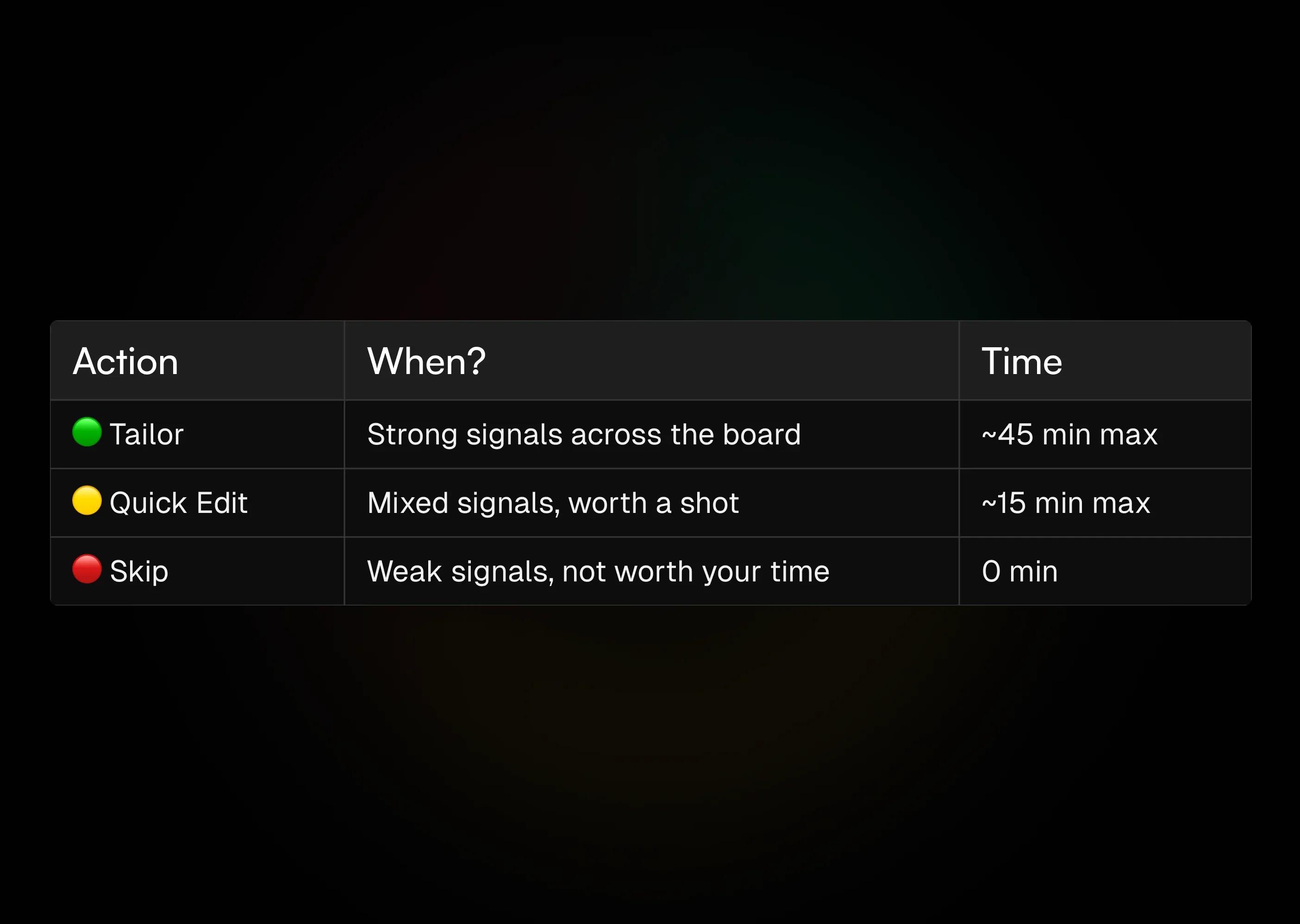
Assess the three signals and decide: Strong across the board? Tailor. Mixed? Quick edit. Weak? Skip.
Exceptions: When the Rules Change
Referral or warm intro
Someone at the company knows your name or is expecting your application. Post age matters way less because the hiring manager will look for you specifically.
Impact: A role that would normally be SKIP or QUICK EDIT upgrades to TAILOR.
Recruiter reached out directly
Not a generic LinkedIn spray. An actual recruiter mentioned the role and asked you to apply. Apply via their email, not the job board.
Impact: Upgrades by one tier (SKIP → QUICK EDIT, or QUICK EDIT → TAILOR).
Unusually niche match
The role asks for a specific combo that only a handful of people have (Rust + embedded systems + automotive domain). Even if the posting is old, there's less competition.
Impact: Upgrades by one tier—worth applying even if signals are mixed.
Track Your Own Data (20 Applications, Then Review)
Don't trust this framework blindly. Test it on your own applications.
Track in a spreadsheet: Create a simple tracker with columns for Job Title, Company, Post Age, Fit, Validation, Date Applied, and Outcome. After 20 applications, review your patterns.
Look for patterns:
- Does your callback rate jump when you apply within 24 hours vs 72+ hours?
- Do roles where you had strong fit proof convert better?
- Are referrals actually working for you, or is it noise?
That pattern is your rule. If your data says 24 hours doesn't matter but validation does, adjust. If referrals don't help in your market, stop chasing them.
The framework is a starting point. Your outcomes are the real answer.
Why This Matters
Graduate hiring at major tech companies is down 50% from pre-2020 levels.[10] More than 60% of software/IT "entry-level" postings now demand 3+ years of experience.[11] The market has structurally shifted.
You can't control the market. You can control where you spend your 15 hours this week.
Same time. Better outcomes.
One More Thing
If most roles score as SKIP, two possibilities:
- You're filtering well. Good. You're not wasting time on junk.
- You're not qualified for most roles you're targeting. Build more projects, broaden your search, or both.
That's the honest diagnosis this framework gives you.
P.S.: Track your data for a month. If this framework works, share it with someone else who's job searching. If it doesn't, tell me what does, your patterns teach all of us what actually matters.
References
[1] Rolling-basis hiring means employers review applications continuously as they arrive, rather than waiting for a deadline. This is standard practice at most startups and many mid-size tech companies.
[2] Huntr. (2025). "Job Search Trends Report Q2 2025." Retrieved from https://huntr.co/research/job-search-trends-q2-2025
[3] Piela, R. (2025). "15 Years of Junior Developer Hiring Data." LinkedIn analysis. Retrieved from https://www.linkedin.com/posts/rpiela_i-analyzed-15-years-of-junior-developer-activity-7391409684269723648-OPj_
[4] Yale School of Management Career Development Office. (2025). "Insights for Students: Understanding 'rolling basis' applications." Retrieved from https://cdo.som.yale.edu/blog/2025/09/24/insights-for-students-understanding-rolling-basis-applications/
[5] Reddit user on r/torontoJobs. (2025). "Decreasing job postings approaching December." Retrieved from https://www.reddit.com/r/torontoJobs/comments/1p08iye/decreasing_job_postings_approaching_december/
[6] Reddit user on r/csMajors. (2024). "My 2024 New Grad Success Story after 1400+ applications." Retrieved from https://www.reddit.com/r/csMajors/comments/1pzaf5d/my_2024_new_grad_success_story_after_1400/
[7] Reddit user on r/jobs. (2016). "Thought: Applying for a job soon after it's listed is greatly beneficial." Retrieved from https://www.reddit.com/r/jobs/comments/47c1ly/thought_applying_for_a_job_soon_after_its_listed/
[8] Reddit user on r/cscareerquestions. (2025). "Referral and Application process for Software Engineering roles in US." Retrieved from https://www.reddit.com/r/cscareerquestions/comments/1pz09zf/referral_and_application_process_for_software/
[9] Reddit user on r/cscareerquestions. (2025). "Why do companies keeps role open almost perpetually in 2025?" Retrieved from https://www.reddit.com/r/cscareerquestions/comments/1pjb9jr/why_do_companies_keeps_role_open_almost/
[10] Talent500. (2025). "Entry-Level Developer Jobs: Market Shifts in 2025." Retrieved from https://talent500.com/blog/entry-level-developer-jobs-2025/
[11] The Interview Guys. (2025). "We Analyzed 2000 'Entry-Level' Job Posts." Retrieved from https://blog.theinterviewguys.com/we-analyzed-2000-entry-level-job-posts/
All it takes is One-Click
Ready for the hunt?