

Share with Community!
Referrals Aren’t a Shortcut. They’re a Different Funnel
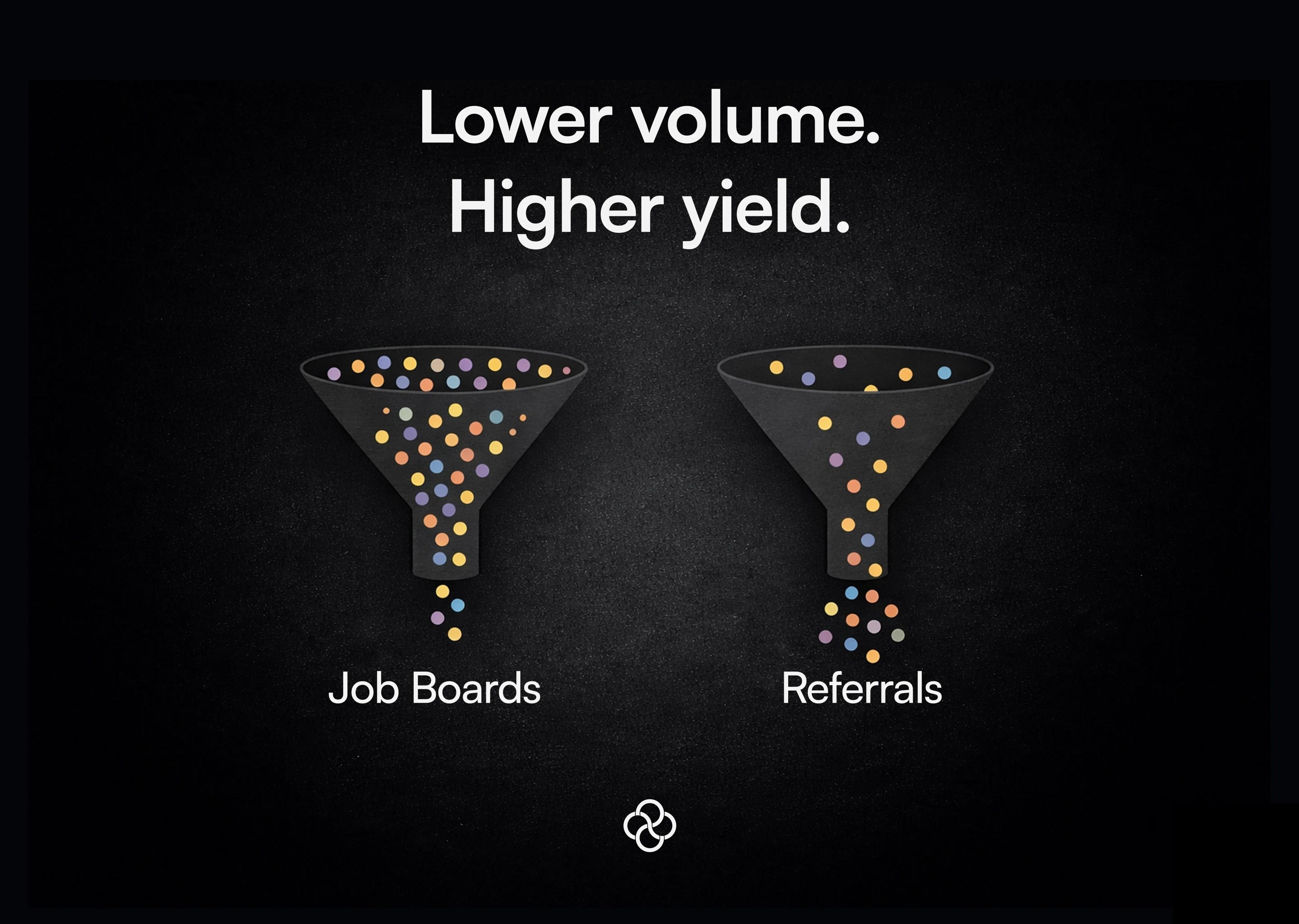
You’ve heard “just get a referral” so many times it sounds like a law of physics. But “referral” is one word for multiple actions. And those actions don’t create the same outcome.
- Referrals don’t guarantee interviews, but they can increase the odds your application gets seen by the right person.
- Referrals usually turn into hires more often than general job applications do. (pattern, not a promise).
- If you fail a hard requirement (like YOE, commute preferences, etc.), a referral usually won’t override it.
- The goal isn’t “get a referral.” The goal is “get the right kind of referral,” fast.
The only pattern that matters (not numbers)
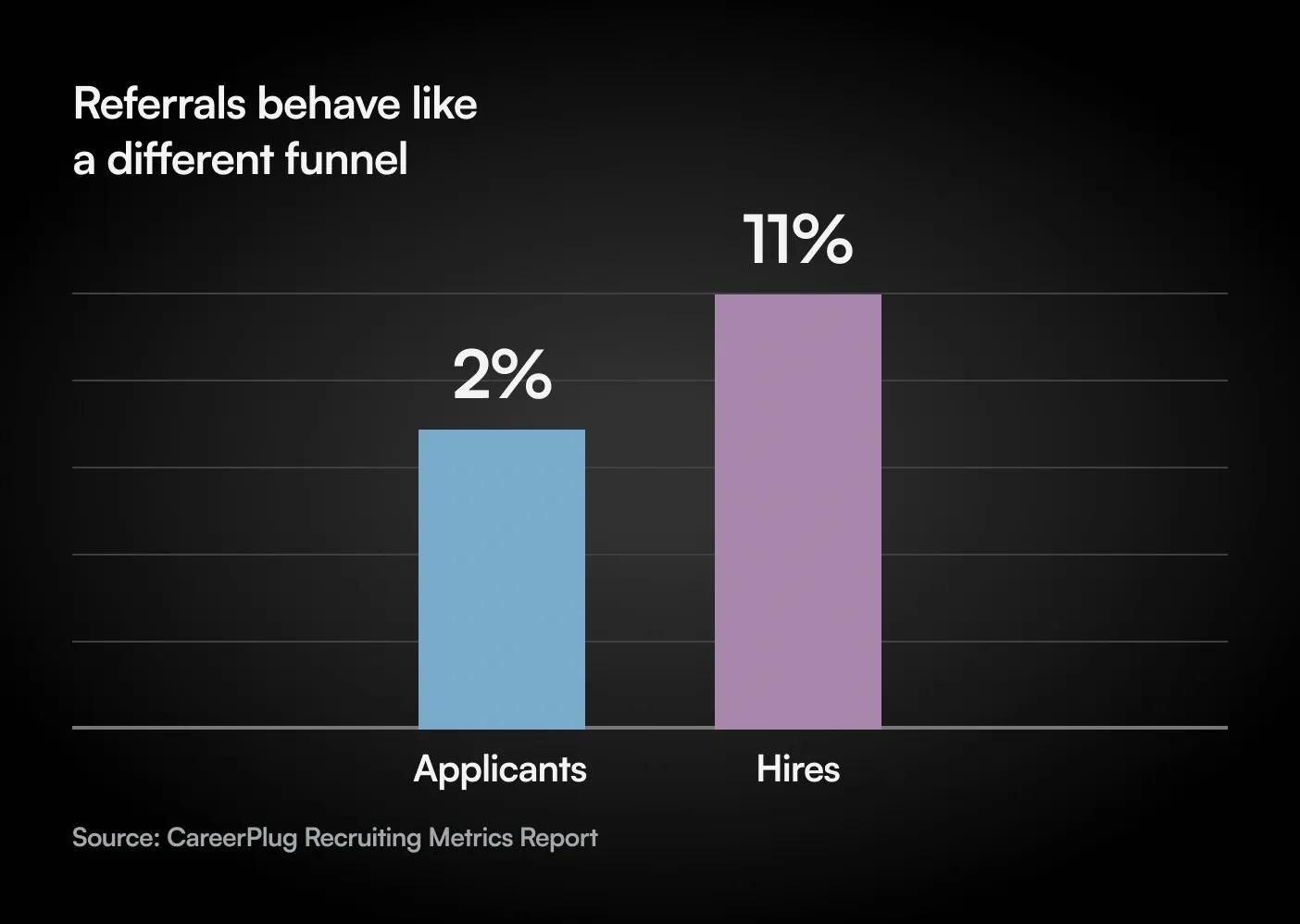
Recruiting benchmarks show that while referrals provide fewer candidates overall, they are far more likely to result in a hire than other sources.
That’s why the referral advice keeps surviving. Not because it bypasses hiring, but because it changes the funnel you land in.
What a referral actually changes
A referral mainly changes visibility and context, not requirements.
- Visibility: your application is more likely to be surfaced to a recruiter or hiring manager.
- Context: a referrer can attach a reason that you’re relevant (instead of the resume doing all the work).
- Requirements: if you fail a gate (knockout questions like work authorization, location, minimum years, certifications), you can still be screened out automatically.
So when someone says “referrals work,” the real question is: What kind of referral are they talking about?
The Referral Ladder (stop treating it as yes/no)
Not all referrals are equal. Most advice fails because it pretends they are.
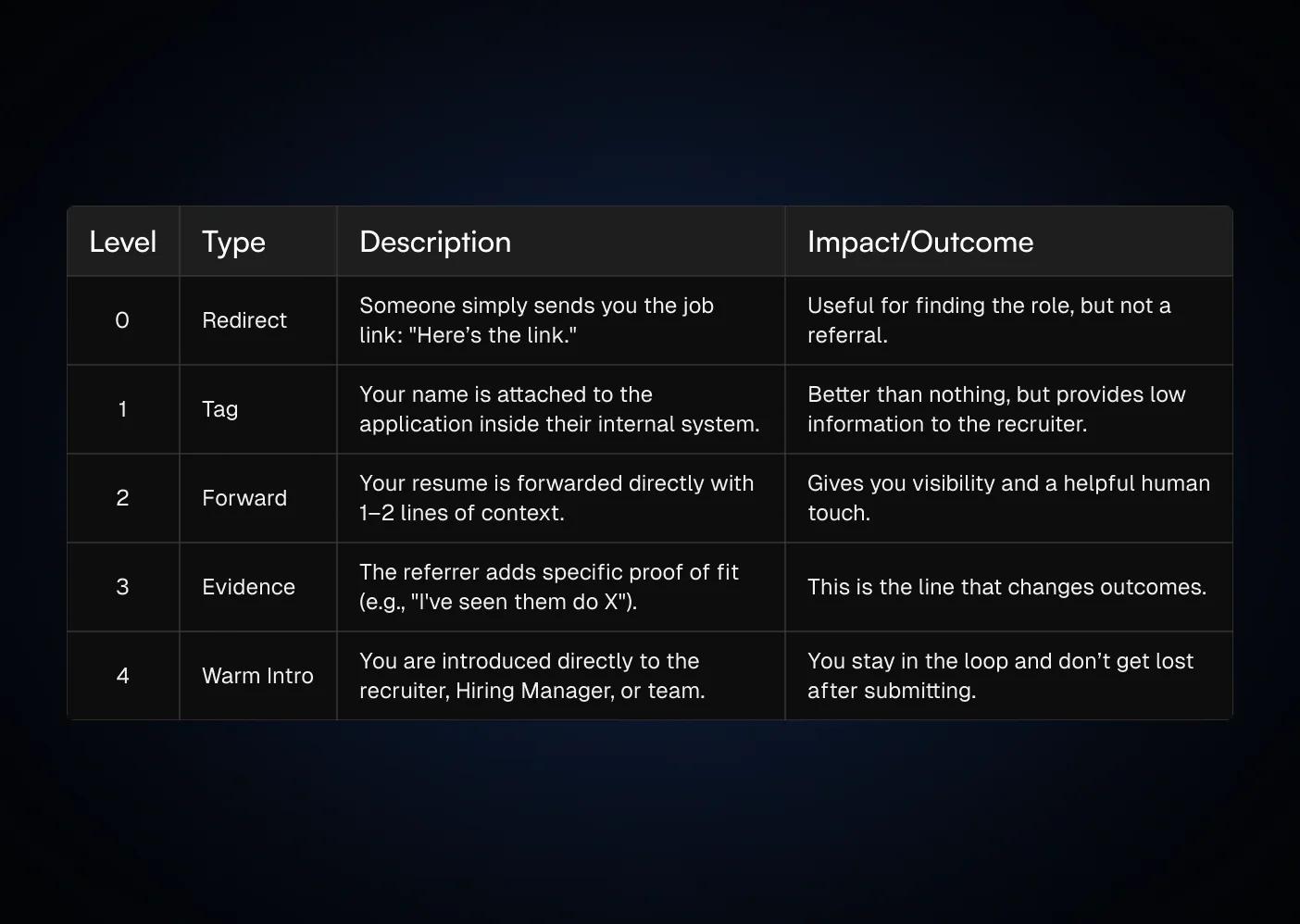
If you only get Level 1, don’t over-invest. If you can get Level 3, it’s worth slowing down and doing it right.
When referrals don’t help (3 cases)
- You fail a hard gate. Knockout questions can auto-disposition candidates in ATS workflows, so even a referral may not surface you into the active review pile. To learn about gates, check out: Why your resume got screened out? The 4 gates.
- The referral has no evidence. A “tag-only” referral may increase visibility a bit, but it doesn’t answer “why you,” which is what moves you from “seen” to “shortlisted.”
- The role isn’t moving. Employers can put roles “on hold” due to changing needs (budget, restructuring, internal changes), so you can submit a strong application into a process that simply isn’t active.
The 10-minute screen (before you ask anyone)
This prevents wasted effort.
1) Proximity
Are they close enough to the role to credibly route you (same org, adjacent team, recruiter relationship)?
2) Evidence
Can they truthfully attach one sentence of evidence? If not, you’re likely capped at Level 1 - 2.
3) Timing cost
Waiting days for a referral reply is a cost. Sometimes the best move is: apply now, then use the referral as a fast follow-up if it lands.
4) Hard requirements (don’t negotiate with them)
Knockout questions can trigger automated rejection inside ATS workflows. If you’re going to fail a gate, the best value of a referral is clarity, not hope.
Two minimal templates
Template 1: Ask for a forward (Level 2)
“Hey [Name], I’m applying for [Role link]. I’m early‑career focused on [Area].”
“Proof: [one link] (project/portfolio/repo).”
“Would you be comfortable forwarding my resume to the recruiter/HM if it’s relevant? Totally fine if not.”
Template 2: Ask for an evidence referral (Level 3)
“Hey [Name], same role: [link].”
“If you’re open to referring, here are 2 bullets you can paste/edit (so you don’t have to invent anything):”
“- Built [X] → [outcome].”
“- Worked with [stack] on [Y].”
“If you’re not comfortable referring, no worries, should I just apply normally?”
That last line is the pressure release valve. It gets you higher probability of a clean yes/no fast.
If you can only get Level 1 referrals
If nobody can truthfully add evidence, chasing referrals harder usually doesn’t fix the problem. Do this instead:
- Build one “evidence asset” you can link in every ask (repo, project, portfolio, short case study).
- Apply where you can prove fit fast (tight match, obvious evidence).
- Ask for a referral only when your packet is copy‑pasteable (role link + proof link + bullets).
References
CareerPlug - Recruiting Metrics Report (benchmarks on applicants vs hires by source; referrals/careers pages vs job boards). Retrieved Jan 9, 2026, from **https://www.careerplug.com/wp-content/uploads/2025/04/Recruiting-Metrics-Report.pdf**
SmartRecruiters - Recruitment Benchmarks 2025 Report (benchmarks including referrals/internal hires share). Retrieved Jan 9, 2026, from **https://ta.smartrecruiters.com/rs/664-NIC-529/images/Recruitment-Benchmarks-2025-Report.pdf?version=0**
Jobvite - Do Employee Referrals Guarantee Interviews? (referrals can improve visibility; not a guarantee). Retrieved Jan 9, 2026, from **https://www.jobvite.com/blog/do-employee-referrals-guarantee-interviews/**
Jobscan - Knockout Job Application Questions: How One Answer Can Kill Your Chances (knockout questions + early elimination mechanics). Retrieved Jan 9, 2026, from **https://www.jobscan.co/blog/knockout-questions-answer-application/**
Indeed - What To Do if the Job You Applied for Is on Hold (what “on hold” means + common reasons). Updated Dec 10, 2025. Retrieved Jan 9, 2026, from **https://www.indeed.com/career-advice/career-development/position-on-hold**
Proism - Why Your Resume Gets Screened Out? The 4 Gates (role can be “on hold” even after you apply; ties to this post’s “role isn’t moving” objection). Retrieved Jan 9, 2026, from **https://proism.app/blog/why-resumes-get-screened-out-ats-gates**
All it takes is One-Click
Ready for the hunt?