

Share with Community!
Your Resume Didn’t Get Rejected by a Recruiter, Here’s What Actually Screened You Out
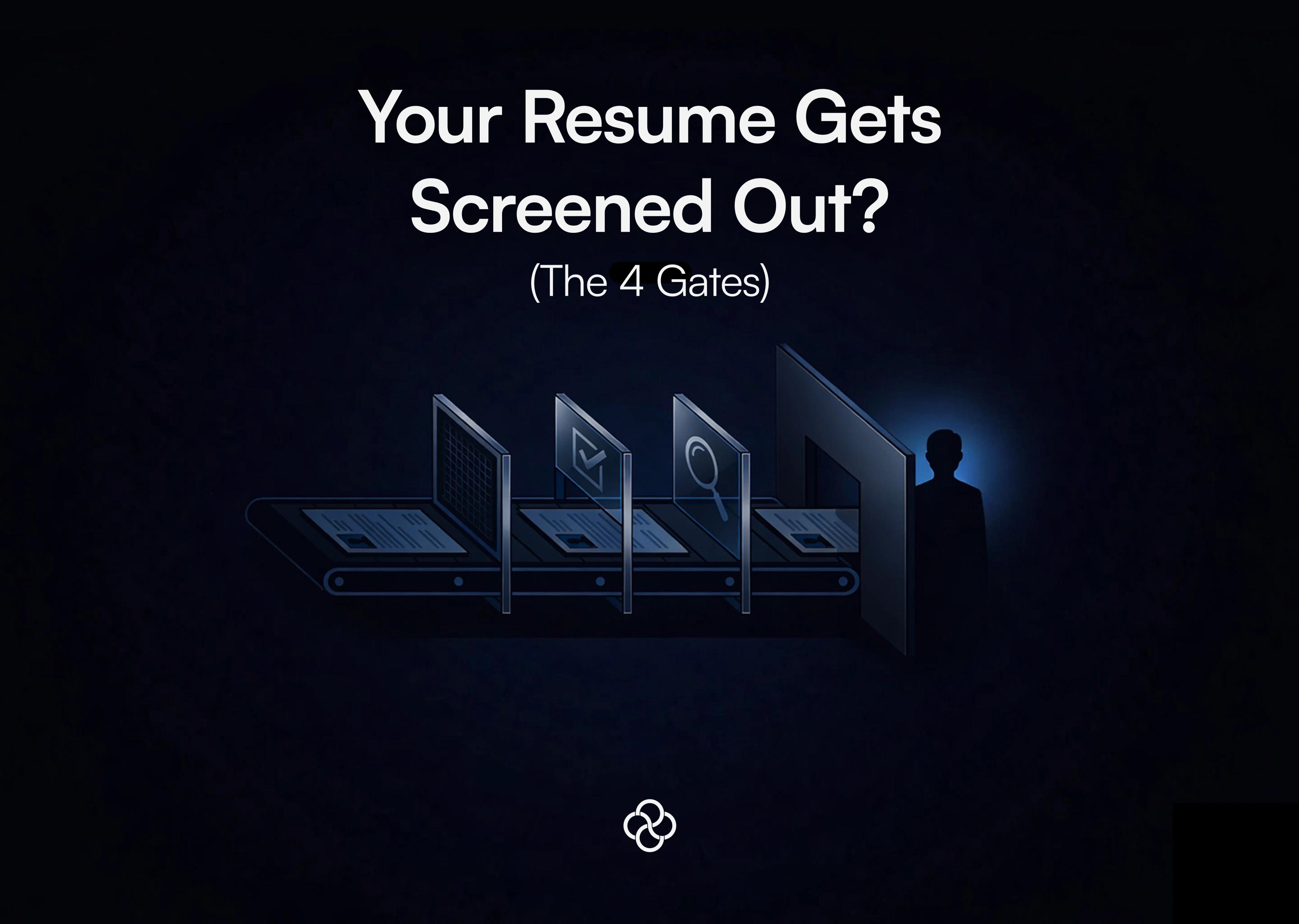
You’ve probably sent 50 resumes this month. Maybe more. You refreshed your inbox after every one. You checked spam and still nothing. Not even a rejection. And the worst part? It often wasn’t a person who decided you weren’t worth talking to. It was a set of hidden filters you never saw, filters that decide if your resume moves forward or gets dropped.
- Your application usually goes through steps like: resume parsing → screening/knockout questions → keyword/relevance ranking → then (maybe) a human looks at it.
- Many “rejections” are not personal. They’re mechanical: the ATS couldn’t read your resume, or one answer triggered an auto-reject.
- Keyword/relevance ranking matters because recruiters use the ATS to search and filter the pile.
- Recruiters can spend only seconds on the first pass, then spend real time only on a short list.
- The checklist near the end helps you figure put where you got filtered out, so you don't have to rewrite your whole resume every time.
What “screened out” means
When you apply online, your resume usually goes into an ATS. ATS helps companies store resumes, filter candidates, and search by skills and requirements. This is extremely common.
Jobscan’s 2025 report found a detectable ATS on 97.8% of Fortune 500 career sites.
Stage 0: The job might be paused
Sometimes the problem isn’t your resume. The role itself can stop moving. Indeed says employers can put a position/s on hold, often due to budget changes, restructuring, or changing needs. And it can happen at many points, sometimes even after collecting applications.
So yes, you can send a strong application into a process that isn’t active right now.
Stage 1: Parsing (can their system read your resume?)
Many ATS “parse” your resume. That means they try to pull your info into fields like work history, dates, skills, and education. Jobscan says that tables and columns may not be read reliably, and broken parsing can cause sections to be skipped or mixed up. They also warn that headers/footers and design-heavy layouts can be risky because some platforms don’t read them consistently.
Common issues in such case:
- Tables/columns that scramble text.
- Text boxes, icons, or graphics that don’t turn into real readable data points.
- Important info placed in headers/footers.
This stage isn’t “Are you good?” It’s “Can their platform turn you into clean data or for that matter read it?”
A very basic way to try if it can be parsed by systems is to just copy the whole resume and paste it in a text document. If its pasted perfectly without breakages there are high chances it will be parsed by ATS systems, and always make sure you are uploading a pdf, other text based document formats don't preserve formatting.
Stage 2: Knockout questions (silent auto-rejections)
These are the yes/no questions in the application form. Examples: work authorization, location, years of experience. The report also explains that knockout questions are used to eliminate candidates early. They describe how certain answers can trigger automated rejection inside the ATSs.
This is why people spiral. You can have a decent resume and still get removed before anyone even compares you to other candidates.
Stage 3: Keyword + relevance ranking
if you pass parsing and knockout questions, the ATS still needs a way to sort hundreds of resumes. Recruiters often use the ATS like a search tool: they filter and rank candidates using things like skills from the job description (and also job titles, education, certifications, and years of experience). The 2025 report found 76.4% of recruiters search and rank candidates by skills from the job description.
This is also why formatting matters: if the ATS can’t read your resume cleanly, your skills and keywords can get missed, and you may not show up when a recruiter searches. The report also explains that scanner compares your resume to the job description (where recruiters take their keywords from) to check if you match what’s being searched in the ATS.
Examples of the keywords recruiters/ATS are looking for (the kinds that decide whether you show up):
- Job title mismatch: “Aspiring Programmer” vs “Software Engineer” (most search the standard title).
- Skill mismatch: “web services” vs “REST API” (they search the exact phrase from the job post).
- Tool mismatch: “cloud” vs “AWS” (they search AWS).
This is how two similar candidates get different outcomes: One can be searched due to right keywords and tags in the systems while other candidate is just missed.
Stage 4: Human review (and finally)
A recruiter can’t review what they never see. TealHQ reports recruiters spend about 7–9 seconds for an initial resume screen(so, practically a scan), and spend much longer (closer to ~20 minutes) on shortlisted resumes.
So don’t aim for “beautiful.” Aim for “obvious in 8 seconds”. Recruiters focus fast on things like your industry, companies, and job titles to judge alignment.
Make it recruiter-friendly (fast):
- Highlight your job role/job title clearly (so they don’t have to guess).
- Make the first 2–3 contributions/bullets proof-based (what you built, shipped, improved), not duty-based. Also, highlight important parts of each statement.
- Put the core tech stack in plain text (so it’s searchable and scannable).
- Keep formatting simple and single-column so both the ATS and the recruiter, scan can work.
Quick diagnostic to debug failure mode: where did you fall off?
Stop asking “Why didn’t they want me?” and ask “Which stage likely removed me?” Use this to debug your last few applications:
Parsing check (Stage 1)
- Is it single column with simple headings?
- Are you avoiding tables/text boxes/icons?
- Is key info outside headers/footers?
Knockout check (Stage 2)
- Did the form ask any screening questions that could auto-reject?
- Were any answers unclear or easy to mis-click?
Search check (Stage 3)
- If a recruiter searched 5 key skills from the job description, would your resume show those skills in real bullets (not just a skills dump)?
Skim check (Stage 4)
- If someone skimmed for 7–9 seconds, would your most recent work clearly match the role?
You’re not trying to be 100% sure. You’re trying to stop guessing, and fix the one thing that’s actually blocking you.
References
Jobscan - Can the ATS Read Tables and Columns on Your Resume? (Jun 12, 2025): **https://www.jobscan.co/blog/resume-tables-columns-ats/**
Jobscan - Knockout Job Application Questions: How One Answer Can Kill Your Chances (Jan 30, 2025): **https://www.jobscan.co/blog/knockout-questions-answer-application/**
TealHQ - How Long Do Recruiters Spend Reviewing a Resume? (Feb 25, 2025): **https://www.tealhq.com/post/how-long-recruiters-spend-reviewing-resume**
Indeed - What To Do if the Job You Applied for Is on Hold (Updated Dec 11, 2025): **https://www.indeed.com/career-advice/career-development/position-on-hold**
Jobscan - ATS Usage Report (2025 Fortune 500 detection + recruiter ATS usage stats) (data gathered Jun 2, 2025): **https://www.jobscan.co/blog/fortune-500-use-applicant-tracking-systems/**
All it takes is One-Click
Ready for the hunt?